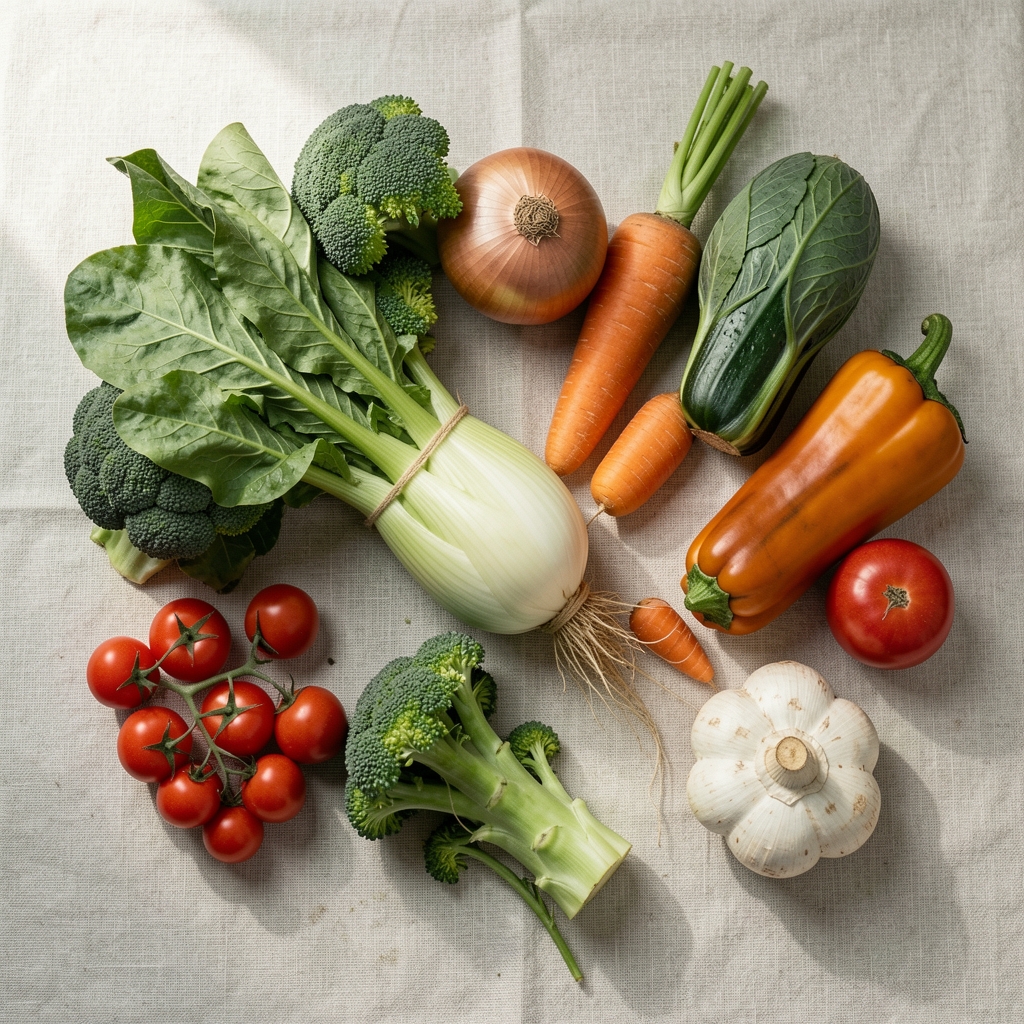
London, January 2026. The Exmouth Market stalls carried eight varieties of vegetable in the third week of January. Four of them were root vegetables. One — a yellow-fleshed sweet potato variety — was new to the display. This field note records how those eight varieties moved through the week, and what their presence on the plate revealed about weight awareness and daily energy across five working days.
The January Plate: What Seasonal Availability Actually Looks Like
January in London narrows the produce window considerably. The transition from the relative variety of autumn — squashes, beetroot in three colours, fennel, late courgettes — to the sterner inventory of mid-winter is gradual but definitive. By the third week of January, the root vegetable category dominated: parsnips, swede, celeriac, carrots in both standard and chantenay form, and the sweet potato mentioned above. Green vegetables were present but limited: savoy cabbage, Cavolo Nero, and a sparse showing of sprouting broccoli described as "early season" by the market trader.
This is the January baseline. It is worth documenting because the standard narrative around diet and weight tends to ignore seasonality as a practical constraint. Nutritional guidance often presents a uniform abundance — "eat a wide variety of vegetables" — without acknowledging that the practical variety available to an urban London resident in mid-January is substantially different from what the same resident encounters in September. The body's weekly food rhythm is partly a function of what the season actually offers.
For this field note, vegetables were purchased on Monday morning and their journey through the week — what was cooked, in what combinations, at what times — was recorded daily. The subject is the editor's own kitchen. The record is observational, not prescriptive.

Monday to Wednesday: The Weight of Root Vegetables on the Plate
Monday evening: a roasted celeriac with Cavolo Nero and a small portion of lentils. The celeriac was heavy — nearly 800 grams before preparation — and yielded enough for two meals. This is characteristic of root vegetables in winter cooking: they are dense, they expand when roasted, and they produce a sense of fullness that lighter vegetables do not sustain through the evening.
The observation relevant to weight and daily energy: the portion consumed was smaller than it would have been with a summer vegetable base. The roasted celeriac occupied more volume on the plate than its raw weight suggests. Portion awareness, in this context, is partly automatic — the body responds to volume and texture, not only to calorie notation.
Tuesday: the remaining celeriac formed the base of a lunch soup. Parsnip added later in the week produced a notably sweeter result — a quality that parsnip brings to winter cooking in a way that confuses the expectation of savoury. By Wednesday, the pattern was established: root vegetables were anchoring every main meal, the Cavolo Nero was providing the only bitter note, and the sweet potato remained unused.
From a nutritional balance perspective, the week's first three days were high in fibre and satiety. The absence of lighter, water-dense vegetables — tomatoes, courgettes, cucumber — that are commonplace in summer meant the plate was heavier in texture and more uniform in colour. This is not a deficiency; it is a seasonal adjustment. The weekly food rhythm in January is simply different from July.
"Root vegetables carry weight in a way summer produce does not. The plate feels anchored. The body does not ask for more by eight in the evening."
Field Note, Vol. I, No. 1 — 15 January 2026
Thursday and Friday: The Sweet Potato and What Changes at the End of the Week
The sweet potato was introduced on Thursday. Its presence altered the week's balance considerably. Where the earlier root vegetables produced warm, earthy, occasionally bitter flavour profiles, the sweet potato introduced a pronounced sweetness and a softer texture when roasted. It combined straightforwardly with the sprouting broccoli, which by Thursday was slightly wilted but still functional.
The nutritional observation from a weight awareness perspective: the sweet potato meal produced less subsequent hunger than the parsnip-based meals earlier in the week. This is consistent with what published nutritional research suggests about the relationship between complex carbohydrates, fibre content, and satiety — the sweet potato's fibre and satiety contribution is substantial, and the portion required to feel appropriately full is smaller than the volume of the vegetable itself might suggest.
Friday closed the week with the remaining Cavolo Nero, flash-fried with garlic, alongside a carrot and swede mash. A simple arrangement, but one that illustrated the way cooking from scratch — home-cooked meals rather than pre-prepared options — keeps the relationship between the cook and the ingredient active. When you are boiling, mashing, and seasoning a swede, you are also making decisions about portion, fat content, and texture that a pre-packaged product has already resolved in your absence.
Five days. Eight vegetables. The record shows a week shaped almost entirely by what January in London actually provides. Weight awareness in this context is not about restriction — it is about understanding what the season places in front of you and cooking with it attentively.
- 01 Root vegetables support nutritional variety in daily diet through winter months when lighter produce is limited.
- 02 Dense vegetables contribute to a sense of fullness between meals — portion awareness becomes partly automatic when volume and texture are present.
- 03 Seasonal produce cycles change the weekly food rhythm substantially — the January plate and the July plate are nutritionally different documents.
- 04 Home-cooked meals allow portion and ingredient awareness that pre-prepared alternatives obscure.
The Relationship Between Seasonal Produce and Gradual Weight Change
It is a consistent observation, noted across multiple field records in this Notebook, that the transition between seasonal periods is when weight awareness is most active. Moving from autumn to winter, the body encounters a shift in the texture, density, and sweetness profile of its primary vegetable intake. This is not, in itself, a problem — the body is adaptable. But the shift is worth noticing.
What the January record demonstrates is that a whole foods approach — seasonal produce, home-cooked meals, attention to portion — does not require elaborate planning. It requires awareness of what is available and a cooking practice that remains engaged with the ingredient. The nutritionist's perspective on weight, in this context, is not prescriptive. It is observational: look at what you are eating, notice when it changes, and pay attention to how those changes affect your daily energy and hunger patterns.
Gradual weight change — in either direction — follows patterns of eating that are sustained over weeks, not single meals. The weight of a January week of root vegetables is different from a July week of salads and courgettes. Neither is superior. Both are records of a season.
The next field note in this series will document the February produce window, which historically in London begins to shift again around the third week as forced rhubarb and early purple sprouting broccoli enter the market. The record continues.
Methodology Note: How This Record Was Kept
The food journalling approach used for this record is straightforward: a single daily notation of main meals, including primary vegetable present, approximate portion size (described in volume terms: a small bowl, a half-plate, a generous portion), cooking method, and any observable effect on hunger or energy through the subsequent hours.
No calorie counting was involved. The record is qualitative: observations, not measurements. Content published by Draloven Notebook is selected based on published nutritional research and reviewed for editorial accuracy by a second editor before publication. The observations above are the editor's own, from the editor's own kitchen.
Articles published on Draloven Notebook are editorial in nature and reflect the writers' observations on everyday nutrition practices and weight awareness. The content is not intended as professional advice, nor as guidance for the management of any specific condition. Readers with specific concerns about their daily routines are encouraged to speak with a qualified wellness professional.